As anesthesia staffing challenges continue to pressure health systems nationwide, one theme is becoming increasingly clear. What worked even five years ago is not consistently delivering stability today. Procedural volume continues to rise, care is becoming more complex, and clinician expectations around flexibility and work-life balance are shifting. Against the backdrop of ongoing anesthesia shortages, many leaders are asking a practical question: What is the next phase of anesthesia staffing, and what helps move a program from constant adjustment to sustained stability?
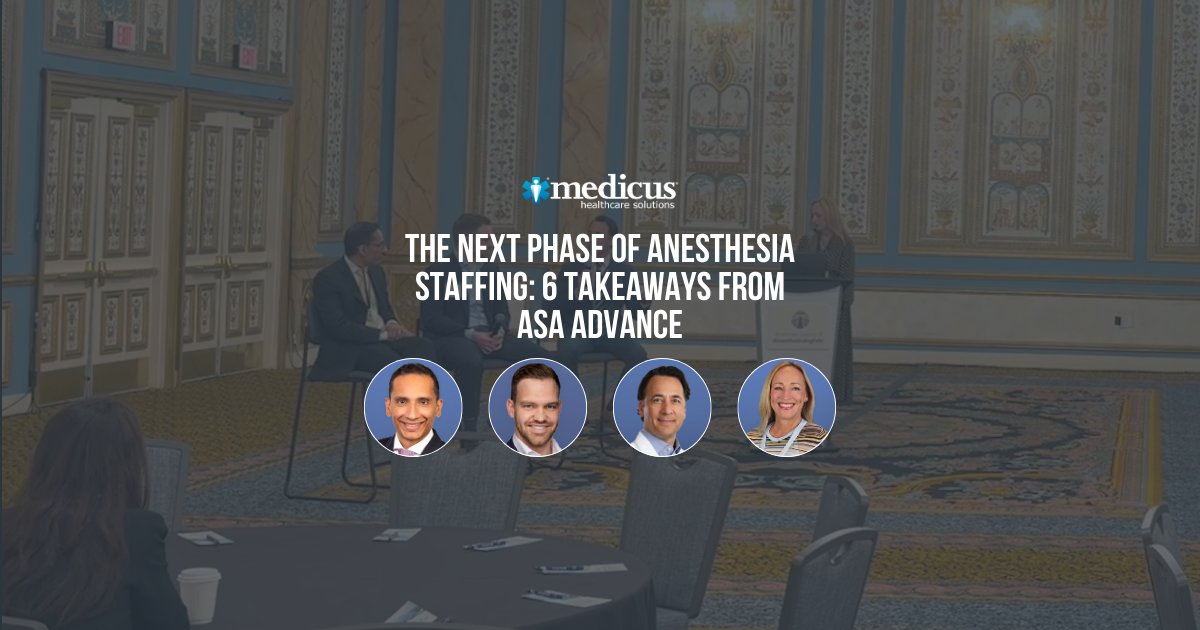
During ASA Advance, Medicus hosted an interactive panel discussion with three anesthesia leaders from Endeavor Health who shared how their health system is evolving anesthesia staffing strategies with stability in mind.
Panelists Included:
 |
Mohammed Minhaj, MD, MBA, FASA, FACHEHarris Family Foundation Chair, Department of Anesthesiology, Critical Care and Pain Medicine, NorthShore, Swedish, and Northwest Community Hospitals |
 |
Matthew BelangerSystem Vice President, Surgical Services & Anesthesia at Endeavor Health |
 |
Francesco Sessa, MS, MBA, CRNAChief Nurse Anesthetist at Endeavor Health |
1.) Anesthesia Care Team Models Can Make Daily Coverage More Resilient
Throughout the discussion, anesthesia care team models emerged as a practical way to maintain consistent daily coverage while still allowing programs to scale. From Sessa’s perspective, the value of anesthesia care team models becomes most apparent when the day changes quickly, such as during emergencies, unexpected acuity shifts, or critical events that require immediate support. Anesthesia care team models can also support a more sustainable day for clinicians by making it easier to redistribute coverage and reduce the burden of clinicians being isolated in rooms without relief.
“It really allows us to have incredible flexibility when that emergency comes in, and we have the ability to move things around staffing in the moment,” Sessa said. “If there is a critical event, there’s a second set of hands available.”
Dr. Minhaj shared that after his team introduced an anesthesia care team model at a hospital site, performance and momentum changed in ways that were visible to both clinical and operational stakeholders. He described record case volume and continued improvement over time, which created space to shift focus toward optimization and growth planning rather than day-to-day coverage strain.
“The hospital had its highest number of cases ever,” Dr. Minhaj explained, emphasizing that “it wasn’t just a one-time success because we built upon that.”
2.) Technology and Data Support More Intentional Anesthesia Staffing Decisions
Panelists described data as a way to move anesthesia staffing decisions from reactive to planned, especially when variability follows repeatable patterns. Dr. Minhaj shared that reviewing historical staffing trends helped his team identify predictable periods of overstaffing and proactively redesign coverage. In his experience, this approach protected coverage while also creating more predictable time away for clinicians.
“We went back, and we looked over the years,” Dr. Minhaj said. “It was like the same thing again and again and again,” which allowed the team to “prospectively… just essentially staff fewer individuals” during that period.
Belanger also discussed using multiple measures to understand how effectively fixed operating room capacity is being used, including block release patterns and backfill performance. He noted that his team reviews utilization across different time windows, including prime time and off-hours, and tailors block release strategies by service based on when cases are typically posted to the schedule. In his experience, these data-informed adjustments supported more intentional coverage planning and capacity decisions.
3.) Flexibility Is a Key Lever to Attract and Retain Talent
When the discussion turned to retention, the panel emphasized that flexibility is less about perks and more about aligning with the workforce realities leaders are seeing today. Sessa described how scheduling needs change over the arc of a clinician’s career, and how departments that can accommodate shifting FTE levels, call options, and self-scheduling structures are better positioned to retain talent long term. He also noted that flexibility works best when it is paired with culture, collaboration, and shared responsibility for covering the schedule.
“When they’re new graduates, they’re very interested in picking up extra shifts,” Sessa said. “And then something happens at home and their family’s growing and all of a sudden I need to pull back and my FTE is going to decrease.”
Dr. Minhaj added that flexibility extends beyond physicians and CRNAs, noting that anesthesia technician support is often overlooked and affects efficiency and the day-to-day burden on clinicians.
“One of the huge overlooked things is the anesthesia tech support for departments,” Dr. Minhaj said. “Our anesthesiologists, our CRNAs, they also deserve to have technicians that help to do some of the things that often fall upon our providers.”
4.) Project-Based Staffing Can Help Leaders Move from Reactive Coverage to Long-Term Planning
Sessa shared a clear example of what reactive staffing can look like when a program expands quickly. His team was tasked with ramping up staffing across 30 anesthesia locations, and the approach that worked in smaller expansions became unmanageable at that scale. When leaders spend their time coordinating multiple locum relationships, vetting candidates, and pushing credentialing, strategic work gets set aside.
“We thought we’d just scale what we had learned in the past,” Sessa said, but “very quickly we learned that was impossible, we could not keep up with the demand that was needed to cover 30 anesthesia locations.”
He described shifting to an exclusive project-based program with Medicus as the turning point. The Medicus Transition Program provided operational support that enabled leaders to focus on building the department’s culture and long-term vision while engaging perioperative partners around a shared goal of keeping rooms running.
The Medicus Transition Program, Sessa explained, “was a game changer because then we could focus on the vision of the culture for this new department and not just sort of the administrative passes.”
5.) Communication and Feedback Loops Helped Sustain Change During Expansion
Panelists described communication as a practical operating discipline, particularly when staffing models, schedules, and coverage expectations were evolving. Belanger noted that changes landed better when leaders invested in proactive communication and created a regular cadence for sharing strategy and performance updates.
“We’ve learned now to have more of those conversations upfront,” Belanger said, adding that “when there’s regular cadence to that, and it’s not just pulling people together to announce something, it’s creating that particular connection.”
Sessa echoed that point, noting that communication becameeven more important as departments expanded. “Communication’s incredibly important,” he said, pointing to a shift in more frequent updates andmore intentional opportunities for feedback.
6.) Investing in Onboarding and Clinical Readiness Supports Long-Term Stability
The panel also emphasized that staffing stability depends not only on hiring but on preparing clinicians to succeed in today’s care environment. Dr. Minhaj noted that as higher-acuity cases move into community settings, newer clinicians may require longer onboarding and more structured development than in the past.
“We have found that the onboard time is a little bit longer,” Dr. Minhaj said. “We’ve got to invest more in terms of that period of time that we get them comfortable.”
He described responding to this shift by investing in more structured onboarding, including focused preparation and time in subspecialty areas to help clinicians adjust to the broader range of cases they will encounter outside of academic medical centers.
Belanger also pointed to trainee rotations as a way to support both development and recruitment. In his experience, longer rotations allow trainees to evaluate the program while giving leaders insight into fit before making long-term hiring decisions.
Looking Ahead
As the discussion wrapped up, session attendees were asked to identify the most important building block of a resilient anesthesia workforce. Flexibility emerged as the most common response, followed by communication, transparency, and trust. Those themes closely mirrored the panelists’ perspectives across care models, planning, retention, and change management.
In the coming weeks, Medicus will share a more in-depth look at each of these takeaways, drawing on additional insights from the discussion and audience perspectives shared during the session.
Interested in learning more about the Medicus Transition Program? Complete the short form below to connect with a member of the Medicus team.