
The Interstate Medical Licensure Compact, often called the IMLC, is an agreement among participating states that helps eligible physicians obtain medical licenses in multiple states through an expedited process. Rather than completing the full licensure application separately in each state, qualified physicians can use the IMLC to streamline the process while still receiving individual licenses from each participating state.
For physicians exploring locum tenens, telemedicine, relocation, or broader career flexibility, the IMLC can make multistate practice more accessible. In this guide, we answer common questions about IMLC requirements, participating states, the application process, and how the Compact may support physicians interested in practicing across state lines.
Answers to Five Common Questions About the IMLC
1.) Who Qualifies for the IMLC?
To qualify for the IMLC, physicians must possess a valid, unrestricted medical license in an IMLC-recognized state, also known as the State of Principal License (SPL). To designate a State of Principal License (SPL), physicians must meet at least one of the following criteria in that state:
- Their primary residence is in the SPL
- At least 25% of their practice of medicine occurs in the SPL
- Their employer is located in the SPL
- They use the SPL as their state of residence for U.S. federal income tax purposes
Physicians must maintain the SPL status throughout the process to stay active within the Compact. Once a physician receives a Letter of Qualification to participate in the IMLC, they may change their SPL. Additional requirements may include graduation from an accredited medical school, board certification, and a clean disciplinary history.
Visit the IMLC website to learn more about additional application requirements.
2.) How Does the IMLC Process Work?
Once the SPL has confirmed a physician meets the qualifications and requirements to join the IMLC, the SPL will issue the physician a Letter of Qualification, authorizing them to participate in the Compact. After receiving the Letter of Qualification, physicians select the participating states where they wish to obtain licensure and pay the applicable fees. Those states then complete final processing and issue individual medical licenses.
3.) Which States Have Implemented the IMLC?
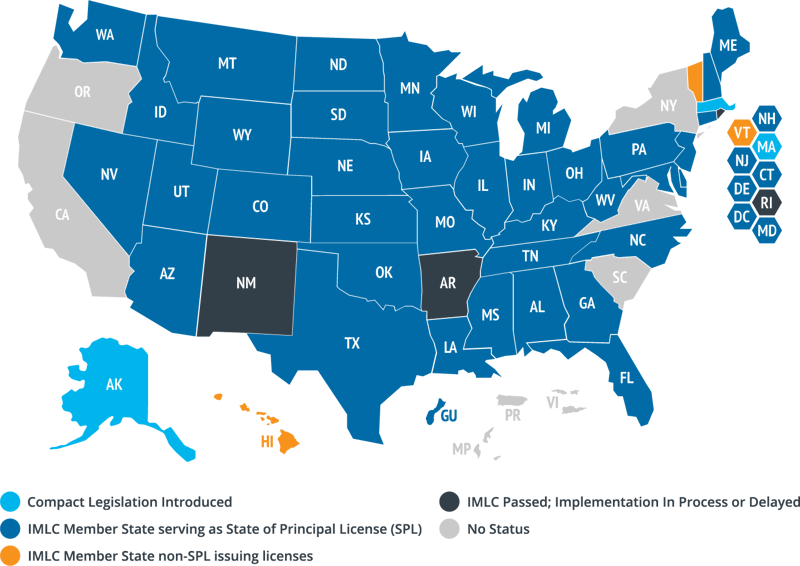
Currently, 40 states, the District of Columbia, and Guam have implemented the IMLC. Participation continues to evolve as more states consider joining the Compact to support a faster, more streamlined licensing process amid ongoing physician shortages and the growth of locum tenens.
States and Jurisdictions That Have Implemented the IMLC
Alabama, Arizona, Colorado, Connecticut, Delaware, District of Columbia, Florida, Georgia, Guam, Hawaii*, Idaho, Illinois, Indiana, Iowa, Kansas, Kentucky, Louisiana, Maine, Maryland, Minnesota, Michigan, Mississippi, Missouri, Montana, Nebraska, Nevada, New Hampshire, New Jersey, North Carolina, North Dakota, Ohio, Oklahoma, Pennsylvania, South Dakota, Tennessee, Texas, Utah, Vermont*, Washington, West Virginia, Wisconsin, Wyoming.
*Hawaii and Vermont are not currently available as SPL, which means physicians can get a license for these states through the Compact when they qualify through another SPL, but neither of these states qualifies as an SPL for licensing in other states.
Questions regarding the current status and extent of each state’s or board’s participation in the IMLC should be directed to the respective state medical board.
Arkansas, New Mexico, and Rhode Island have passed IMLC licensure legislation, but implementation is still in process or delayed. Alaska and Massachusetts currently have IMLC legislation pending. The remaining states and territories do not currently offer IMLC participation. Since state participation can change over time, physicians should visit the official IMLC website for the most up-to-date information before beginning the application process.
4.) Can Physicians Apply for More Than One State License at a Time With the IMLC?
Yes. Physicians can apply for licenses in multiple participating states simultaneously. Once a Letter of Qualification is issued, all selected states begin final processing simultaneously, so there is no need to wait for one license before starting the next.
This is a major advantage over the traditional process, where applying on a state-by-state basis can add weeks or months to the overall timeline. Physicians who identify their target states before applying can submit all requests at once and avoid unnecessary delays. For those pursuing locum tenens work, telemedicine, or a multistate practice, this can significantly reduce the time between application and being ready to work.
5.) What Are the Benefits of the IMLC for Locum Tenens Physicians?
For locum tenens physicians, licensing can play an important role in how quickly they can accept opportunities in different states. The traditional state licensing process can take several weeks to several months, depending on the state, specialty, and application requirements. Through the IMLC, eligible physicians may obtain licenses in participating states within days or weeks.
That expedited pathway can give locum tenens physicians greater flexibility when evaluating locum tenens jobs across state lines. With additional licenses in place, physicians may be better positioned to respond to locum tenens jobs that align with their preferred locations, schedule, and career goals.
Navigating the Multistate Licensure Process for Locum Tenens
By simplifying and accelerating the physician licensure process, the IMLC can make it easier for physicians to expand where they practice. For physicians interested in locum tenens, that flexibility may open the door to more opportunities across participating states and a broader range of practice settings.
When you partner with Medicus, you also gain access to an in-house licensing team that can help answer questions, navigate state licensure requirements, and support the IMLC process when applicable.
Interested in working locum tenens with Medicus? View our open locum tenens jobs or complete the short form below to connect with a Medicus recruiter.
Frequently Asked Questions About the Interstate Medical Licensure Compact
How Long Does it Take to Get Licensed Through the IMLC?
Eligible physicians may receive licenses in participating states within days or weeks after approval, though processing timelines vary by state.
Can Locum Tenens Physicians Use the IMLC?
Yes. Locum tenens physicians may use the IMLC to apply for licenses in multiple participating states when they meet the Compact’s eligibility requirements. For physicians interested in locum tenens opportunities across state lines, the IMLC can help streamline the licensing process and support greater career flexibility.
Does the IMLC Issue One License for All States?
No. Physicians receive individual medical licenses from each participating state. The Compact only streamlines the application process.
What is a State of Principal License?
A State of Principal License (SPL) is the state a physician uses to qualify for participation in the IMLC. To designate an SPL, a physician generally needs to hold an unrestricted license in that state and meet at least one qualifying connection, such as primary residence, practice location, employer location, or federal tax residence.