
Blog Highlights
How Physician Assistants Are Expanding Access to Care
Practicing Across the Care Continuum
Bridging Gaps in Care Across Various Medical Specialties
The Added Value of Locum Tenens Physician Assistants
The Benefits of Locum Tenens for Physician Assistants
The Benefits of Locum Tenens Physician Assistants for Healthcare Facilities
Frequently Asked Questions About Physician Assistants
Walk into nearly any care setting today, from a rural clinic to a busy surgical service line, and there's a good chance a physician assistant is part of the care team. Across specialties and communities, PAs deliver high-quality care and expand patient access, and their adaptability and clinical expertise have made them an integral part of today's healthcare workforce. As the profession evolves, that impact continues to grow.
That evolution is also expanding how PAs practice. For PAs, locum tenens offers a path to greater flexibility and career ownership. For healthcare organizations, it offers a way to maintain coverage, support care teams, and keep patients connected to care.
How Physician Assistants Are Expanding Access to Care
Today, PAs have more than 620 million patient interactions annually. As healthcare demand outpaces workforce capacity, PAs broad clinical training and flexibility across care settings enable them to step into critical roles that strengthen patient access, support continuity of care, and improve system-wide efficiency.
Practicing Across the Care Continuum
PAs show up across the care continuum, from hospitals and urgent care centers to outpatient clinics and beyond. Most of the time, though, you'll find them in an outpatient office or clinic, which employs the largest share of PAs, according to the AAPA Salary Survey. That makes them a familiar face for patients seeking both primary and specialty care.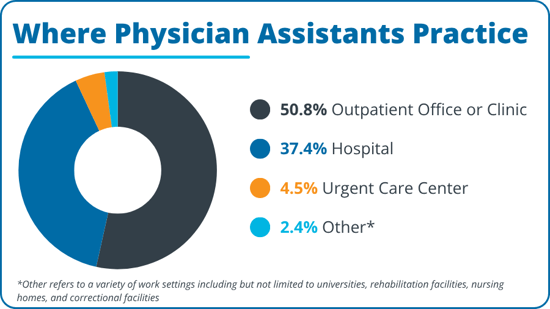
Bridging Gaps in Care Across Various Medical Specialties
PAs also practice across nearly every area of medicine, giving healthcare organizations greater flexibility to support different patient populations and service lines. Their reach spans primary care, emergency medicine, internal medicine subspecialties, surgical specialties, and more, with surgical specialties accounting for the largest share in the AAPA Salary Survey.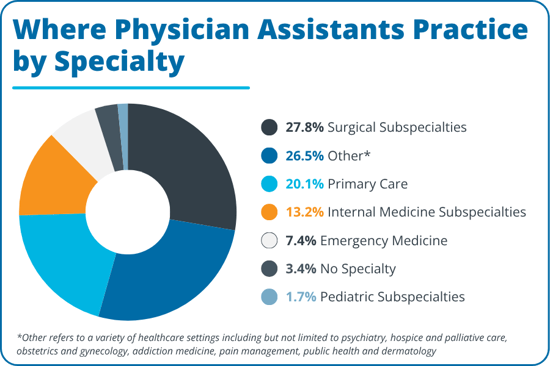
Strengthening Patient-Centered Care
Beyond expanding access, PAs also play an important role in the patient experience. Their combination of clinical expertise, communication, and advocacy can support stronger continuity and collaboration across care teams. That connection is reflected in public perception, with 90% of U.S. adults identifying PAs as trusted healthcare providers.
That trust, paired with rising demand for care, is fueling continued growth. The U.S. Bureau of Labor Statistics projects physician assistant employment to grow 21% from 2025 to 2035, making it one of healthcare's fastest-growing professions.
The Added Value of Locum Tenens Physician Assistants
Physician assistants already play a vital role in expanding access to care, and locum tenens extends that reach even further. For PAs, it opens the door to new settings and experiences. For healthcare organizations, it delivers flexible coverage that strengthens clinical teams and supports uninterrupted patient care
The Benefits of Locum Tenens for Physician Assistants
- Career Growth and Clinical Variety: Locum tenens jobs expose physician assistants to different practice settings, patient populations, and care models, helping them broaden their experience and build new skills throughout their careers.
- Greater Work-Life Balance: Unlike traditional W-2 employment, locum tenens allows physician assistants to choose locum tenens jobs that align with their personal and professional goals, creating greater control over when, where, and how they work.
- Competitive Earning Potential: High demand for physician assistants across various specialties and practice settings often creates opportunities for increased compensation compared to traditional employment models.
- Travel Opportunities: With locum tenens physician assistant jobs available nationwide, locums offer PAs the chance to experience new regions, healthcare environments, and patient populations.
The Benefits of Locum Tenens Physician Assistants for Healthcare Facilities
- Continuity of Care: Locum tenens physician assistants help maintain consistent patient access during leave, seasonal surges, and ongoing staffing shortages.
- Service Line Support: Organizations can leverage locum tenens physician assistants to sustain or expand services while recruiting permanent clinicians or evaluating long-term staffing needs.
- Community Access: Locum tenens physician assistants expand access to care, particularly in rural areas, helping healthcare facilities reach patients who might otherwise go without care.
- Clinician Well-Being: By supporting overextended teams, locum tenens physician assistants help reduce workloads, support time off, and prevent burnout among full-time staff.
Interested in partnering with Medicus? Complete the short form below to connect with a member of the Medicus team.
Frequently Asked Questions About Physician Assistants
How Many Physician Assistants Are There in the United States (U.S.)?
There are more than 200,000 physician assistants working in communities nationwide, according to the AAPA.
How Many Physician Assistants Work Locum Tenens in the U.S.?
According to Medicus’ proprietary data, about 5% of physician assistants have worked or are currently working locum tenens, equivalent to roughly 1 in every 18 PAs.
What Is the Average Age of Physician Assistants in the U.S.?
Approximately half (53%) of Aps are under the age of 40, according to the AAPA.
How Long Does It Take to Become a Physician Assistant?
It takes an average of six to seven years to become a physician assistant. To obtain a license, PAs must graduate from one of the 330 PA programs and complete 100 hours of continuing medical education every two years to maintain certification, according to the AAPA.
Can Physician Assistants Practice Independently?
The short answer is that it depends on the state. While a growing number of states are modernizing their regulations, most do not explicitly use the term “independent practice.” Instead, states outline levels of oversight or collaboration for PAs, such as whether a physician must review charts, be available for consultation, or formally delegate. In recent years, many states have shifted toward models that allow healthcare organizations and care teams to define these relationships based on provider needs and expertise. To clarify these variations, the AAPA developed a four-tier framework that categorizes each state’s regulatory environment for PAs as optimal, advanced, moderate, or reduced.
What States Have Optimal Practice for Physician Assistants?
Lawmakers across the country are steadily updating PA practice laws to reflect modern healthcare delivery. While most states stop short of formally defining “independent practice,” the overall trend is toward models that prioritize collaboration and team-based decision-making over prescriptive supervision. As of October 2026, the states with optimal PA practice include Delaware, Iowa, Maine, Montana, New Hampshire, North Dakota, South Dakota, Utah, and Wyoming, according to the AAPA.
What Clinical Settings Do Physician Assistants Work In?
Physician assistants practice in nearly every type of care environment, including outpatient clinics, hospitals, urgent care centers, and other clinical settings, according to the AAPA.
What Specialties Can Physician Assistants Work In?
Physician assistants can practice in nearly every area of medicine, from primary care to highly specialized fields including cardiology, surgery, gastroenterology, emergency medicine, and more, according to the AAPA.
What is the PA Licensure Compact?
The PA Licensure Compact is an interstate agreement that will allow physician assistants licensed in one compact state to obtain practice privileges in other compact states more easily. Although not yet operational, once implemented, it will streamline the licensing process for PAs to provide care across state lines, including through telemedicine.