Four Proven Approaches to Building a Sustainable Clinical Workforce
Health systems continue to face physician shortages, even as they invest in longer-term workforce strategies. Recruiting timelines remain extended, patient demand is rising, and retirements and turnover continue to affect coverage. For many leaders, the challenge is not just stabilizing coverage today but creating a workforce model that can sustain over the long term.
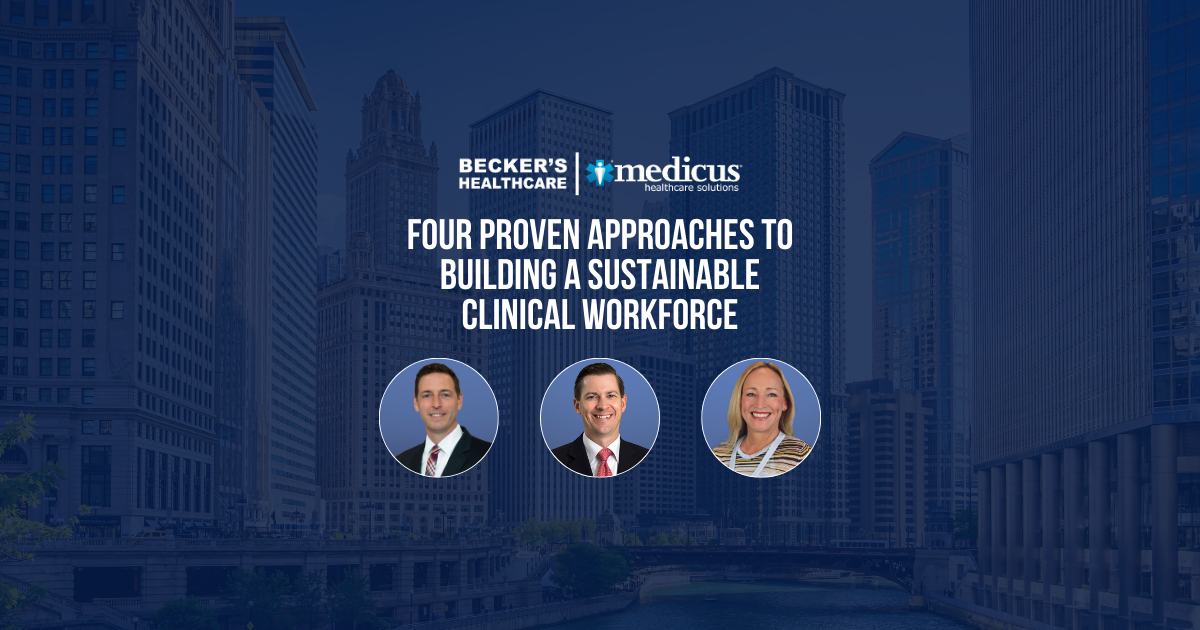
During a Medicus-hosted session at Becker's CEO + CFO Roundtable, two health system leaders shared what has helped their organizations navigate these pressures:
- Matthew Broom, Vice President and Chief Medical Officer at BJC Medical Group
- Michael Loftus, Senior Vice President, Chief Medical and Quality Officer at RWJBarnabas Health
Four themes emerged across their remarks, grounded in their experience leading through workforce strain and building stability within their systems.
Investing in Retention
Both leaders talked about retention as a commitment to their physicians, not just a workforce metric. They acknowledged a reality many healthcare employers know well: replacing a physician is expensive, disruptive, and rarely results in an equivalent role or experience. More importantly, they emphasized that physician departures are preventable when leaders pay attention early and respond with intention.
What Retention Investments Look Like in Practice at BJC Medical Group:
- Identifying turnover risk. Dr. Broom and his team have reset expectations so that leaders proactively flag risks early, including unexpected turnover, coverage strain, or roles that rely too heavily on a single individual. This allows leaders to address issues while there is still time to act.
- Strengthening workforce planning across locations. BJC has been approaching clinicians as long-term investments, with greater visibility into the mix of ages, training, and capabilities across practices and into where the organization may be overextended or underextended.
- Building operational visibility through workforce dashboards. BJC Medical Group has been strengthening its line of sight into staffing levels, practice age distribution, and opportunities to cross-pollinate service lines across the enterprise.
What Retention Investments Look Like in Practice at RWJBarnabas Health:
- Staying visible and responsive to frontline feedback. Dr. Loftus highlighted leadership rounding as a way to listen, respond, and close the loop, using a "You Said, We Did" model that makes feedback feel heard and acted on.
- Choosing long-term stability over speed during transitions. Rather than prioritizing the fastest path forward, leaders at RWJBarnabas Health focus on building trust and strengthening relationships, recognizing that thoughtful transitions create stability for physicians, teams, and patients, especially during times of pressure or change.
- Investing in well-being and burnout prevention. Dr.Loftus described a proactive approach to physician well-being that focuses on reducing unnecessary friction, creating more manageable day-to-day work, and making support visible and accessible. The result is a culture in which physicians feel understood and supported, and able to sustain high-quality care over the long term.
"We've invested a lot in well-being, retention, burnout prevention, and I think that it's not a panacea, right, but it helps, and I think knowing that the organization cares about those things and that they are trying to create a culture. Again, it goes back to collaborative negotiation instead of drawing a hard line in the sand; that's the kind of organization people want to stay at." - Dr. Michael Loftus, Senior Vice President, Chief Medical and Quality Officer at RWJBarnabas Health
Establishing Service Lines
Both leaders highlighted service line structures as a practical response to coverage challenges caused by vacancies, changing demand, or unexpected absences. Instead of relying on individual hospitals or practices to solve shortages independently, service line models align staffing and leadership across sites and create a more consistent, coordinated approach.
How Service Lines Support Coverage at BJC Medical Group:
- Reducing variation across markets by moving towards a shared model. Historically, BJC Medical Group grew one practice at a time, resulting in significant variations across locations. By adopting a service line model, the health system established more consistent expectations and a clearer operating structure across markets.
- Measuring staffing and clinical makeup more consistently across sites. With service lines in place, BJC Medical Group began tracking staffing patterns, clinical structure, and quality metrics that support earlier intervention when a site is under strain.
- Sharing resources across markets when needs shift. Service lines enable cross-market support, strengthening stability when demand spikes or staffing shifts unexpectedly across the health system.
How Service Lines Support Coverage at RWJBarnabas Health:
- System-wide coverage flexibility. Gaps are addressed by reallocating shifts and staff across the system rather than absorbing shortages at a single site.
- Using service line leadership to guide change and integration. When RWJBarnabas Health transitioned its radiology program from outsourced to employed, having reliable service line leadership in place set expectations early and standardized roles and workflows, enabling coverage to flex more easily across the health system.
- Extending hard-to-find specialty coverage. Instead of staffing full specialty teams at every site, work is shared across the system, and care is directed to the locations best equipped to handle it.
"We really leverage those service line connections to make sure that we, as hospital leadership and system leadership, are able to get the resources to the bedside to help that practice thrive. So, I think nimble is kind of the name of the game, you're not really going to be able to predict everything and the ability to get creative and pivot, I think, is serviced best by aggregating the resources you've got and as a system that's what a service line looks like, you can really bring everything into one place." - Dr. Michael Loftus, Senior Vice President, Chief Medical and Quality Officer at RWJBarnabas Health
Strengthening Academic Partnerships
Both leaders described academic partnerships as a practical response to a constrained pipeline. With fewer graduates available and more competition for them, their focus has been on engaging earlier, aligning training with system needs, and building programs that support long-term staffing in the markets and specialties that are hardest to sustain.
How RWJBarnabas Health is Strengthening Academic Partnerships:
- Connecting with clinicians earlier in training by integrating more closely with academic partners. Dr. Loftus emphasized building relationships further upstream so that future clinicians are aware of RWJBarnabas Health before entering the workforce.
- Expanding pipeline planning beyond physicians by investing in nursing and other interprofessional programs. Dr. Loftus described launching a nursing school and engaging earlier with roles such as PAs and technical staff to strengthen the teams that support access.
- Aligning training expansion with system priorities by linking pipeline growth to workforce demand. He noted that growth comes at a cost, and the goal is to expand in areas that align with the organization's anticipated needs.
How BJC Medical Group is Strengthening Academic Partnerships:
- Expanding residency training in academic and community settings. By leveraging large academic programs and building community residency programs in areas such as primary care and hospital medicine, BJC Medical Group is expanding its future pipeline and improving the likelihood of placing clinicians where demand is greatest.
- Building a longer-term "farm system" by treating training expansion as a sustained commitment instead of a quick switch. Dr. Broom emphasized that these programs take time to build, but they strengthen the pipeline needed to meet future demand.
- Staffing in harder-to-fill markets by training clinicians in community settings instead of limiting training to traditional academic environments. Dr. Broom linked community-based residency development to improved long-term recruitment and stability in areas with the most challenging coverage to maintain.
"BJC has a couple of large academic residency programs, and we've also started community residency programs, trying to build our own farm systems in primary care and hospital medicine. Moving into those things, obviously, those aren't easy light switches that you can just do overnight, but they're commitments where we recognize that for us to meet the needs of the workforce from a value-based care standpoint." - Dr. Matthew Broom, Vice President and Chief Medical Officer at BJC Medical Group
Reinforcing Workforce Stability with Interim Staffing Partnerships
Retention, service lines, and academic partnerships strengthen stability over time, but they do not eliminate immediate coverage gaps. Even as health systems implement stabilization strategies, patient demand, retirements, attrition, and backlogs continue to put pressure on access to care.
Health systems like BJC Medical Group and RWJBarnabas Health partner with Medicus to deliver defined, accountable interim coverage that keeps care moving as staffing changes take place. The Medicus Transition Program uses a project-based approach to clinical staffing to protect access, relieve pressure on internal teams, and create the space needed to stabilize and strengthen the clinical workforce.
How Interim Healthcare Staffing Partnerships Can Support Workforce Stability:
- Preserving access to care during vacancies, transitions, or volume surges
- Reducing strain on existing teams so leaders can focus on retention and stabilization
- Creating time and operational breathing room to implement longer-term workforce plans
"We worked with Medicus to provide some bridge locums coverage, which was essential in the short run and really helped provide that safety valve to help the existing radiologists work through a substantial clinical backlog." - Dr. Michael Loftus, Senior Vice President, Chief Medical and Quality Officer at RWJBarnabas Health
Workforce sustainability is rarely driven by a single initiative. As Dr. Broom and Dr. Loftus described, it often reflects a combination of system-level structure, proactive engagement, and long-term pipeline investment, supported by interim healthcare staffing solutions when needed.
If you are evaluating interim coverage as part of a broader staffing strategy, Medicus can help you align short-term staffing support with long-term workforce planning. Complete the short form below to connect with a member of the Medicus team.