
Before you can practice medicine, bill for services, or work locum tenens jobs, you need one crucial piece of identification: a National Provider Identifier (NPI) number. This unique number serves as the foundation for everything from credentialing to reimbursement, and it follows you wherever your medical career may take you.
Thankfully, the NPI application process is straightforward and can be completed within minutes. Whether you are preparing for residency, stepping into your first attending role, or planning to work as a locum tenens physician or advanced practitioner, this guide provides clear answers to common questions and step-by-step instructions to help you obtain your NPI number quickly and without confusion.
How Do I Apply for an NPI Number?
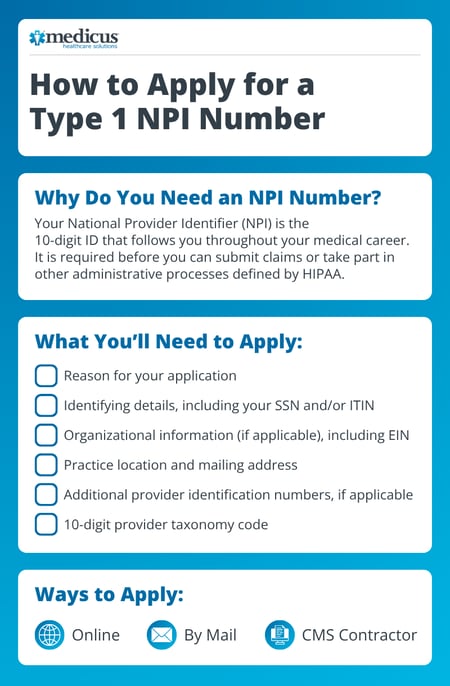
According to the Centers for Medicare & Medicaid Services (CMS), there are three ways to apply for an NPI number:
1. Online: Submit an online application through the National Plan and Provider Enumeration System (NPPES) website. To begin, register with the CMS Identity & Access Management System to create an account. From there, you will complete and submit your application on the NPPES website. After submission, you will receive a confirmation email, and you can use your login credentials to track the status of your application or make updates as needed.
2. By Mail: Complete Form CMS-10114 and send it to the relevant NPI enumerator address:
NPI Enumerator
7125 Ambassador Road, Suite 100
Windsor Mill, MD 21244 -2751
You can also call 800-465-3203, or TTY 800-692-2326, or email customerservice@npienumerator.com to request a hard copy.
3. Through a CMS Contractor: Partner with an Electronic File Interchange Organization (EFIO) to apply on your behalf.
Common Questions About National Provider Identifier (NPI) Numbers
What Is a National Provider Identifier (NPI) Number?
An NPI number is a unique 10-digit number issued by the government as a standard identifier for individual healthcare professionals and organizations in the United States. These numbers do not expire or change throughout your medical career and are used in administrative and financial transactions.
There are two types of NPI numbers:
-
Type 1: For individual healthcare providers, including physicians, advanced practitioners, and sole proprietors. Each individual has only one NPI number, which follows them throughout their medical career.
- Type 2: For healthcare organizations, including hospitals, groups, pharmacies, and other entities that provide medical services.
Healthcare providers who are considered HIPAA-covered entities, including those who bill Medicare, are required to have an NPI. This requirement applies regardless of where you practice, whether in a private office, a hospital, or through locum tenens jobs.
Why Do I Need a National Provider Identifier?
An NPI number is required before you can submit claims or take part in other administrative processes defined by HIPAA. This number acts as the universal identifier that connects your services to payers, health systems, and other healthcare professionals.
Common situations where an NPI is necessary include:
- Submitting claims and encounter reports
- Checking the status of claims
- Coordinating benefits and processing premium payments
- Verifying eligibility, enrollment, or disenrollment
- Managing referrals, authorizations, and more
In short, an NPI ensures that your clinical work is recognized correctly, recorded, and reimbursed across the healthcare system.
What Do I Need to Apply for an NPI Number?
Before submitting your application, make sure you have the following:
- Reason for your application
- Identifying details, including your SSN and/or ITIN
- Organizational information (if applicable), including EIN
- Practice location and mailing address
- Additional provider identification numbers, if applicable
- Your 10-digit provider taxonomy code
Do I Need an NPI Number as a Medical Student or Resident?
While an NPI is not required to enter medical school or residency, residents and some medical students will need one once they begin taking on clinical responsibilities, such as prescribing, ordering, or referring. Applying for an NPI early helps you avoid administrative delays and ensures that you are prepared as your role expands.
Reasons to apply for an NPI number during residency or even late in medical school include:
- Submitting prescriptions and orders: An NPI is required when writing prescriptions, ordering lab tests, or referring patients
- Preventing workflow delays: Pharmacies, labs, and insurers need your NPI to process claims accurately and on time
- Maintaining professional continuity: Your NPI stays with you throughout your career, regardless of role, employer, or state
- Meeting compliance standards: Many residency programs incorporate HIPAA requirements that include NPI registration
Obtaining your NPI during residency or even late in medical school positions you for a smoother transition into your medical career after training.
How Long Does It Take to Get an NPI Number?
The application process typically takes between 15 and 20 minutes to complete. The timeline to receive your unique NPI number depends on the application method and the volume of applications being processed at any given time. Those who submit a properly completed online application could receive their number in as little as 10 days. Those who submit a paper application could expect to wait approximately 20 business days.
How Do I Receive My NPI Number?
Once your application is processed and approved, your NPI number will be sent to you via email from the official NPI Enumerator's office (customerservice@npienumerator.com). To prevent delays, add this email address to your trusted senders list and check your spam or junk folders regularly so you don't miss it.
Am I Responsible for Updating My NPI Information?
Yes. Just as you regularly update your CV, you should also keep your NPI record up to date. If you obtain a new state license or transition out of residency or fellowship, it is your responsibility to update your NPI record.
This responsibility applies to all clinicians, but it takes on added importance in locum tenens practice. Physicians and advanced practitioners in permanent positions may only update their NPI occasionally. Locum tenens clinicians, however, often hold multiple state licenses and practice at several different facilities each year. Credentialing teams check NPI records as part of the credentialing process, which means outdated information can create unnecessary obstacles. Keeping your NPI record current supports smoother credentialing and helps ensure that locum tenens jobs begin without disruption.
Why an NPI Number Is Important for Locum Tenens Jobs
If you’re considering working locum tenens jobs, particularly early in your career, securing your NPI number as soon as possible in your medical career is essential. Locum tenens physicians and advanced practitioners often take on locum tenens jobs across multiple states and facilities, making your NPI number a constant identifier that ensures your work is recognized wherever you practice. This is because your NPI number is used by hospitals, clinics, credentialing teams, and more to verify qualifications, process billing, and maintain compliance with payer and HIPAA requirements.
An active and accurate NPI also helps prevent delays when starting new locum tenens jobs. Outdated information can slow down credentialing, which is especially critical when facilities are relying on locum tenens coverage to address urgent staffing shortages. By applying for your NPI number before beginning locum tenens jobs and keeping it updated, you streamline the credentialing process and set yourself up for smoother transitions between locum tenens jobs.
How Partnering with a Locum Tenens Agency Can Help with NPI Updates
Once you have your NPI number, keeping it up to date is an ongoing responsibility. For locum tenens physicians and advanced practitioners, who often hold multiple state licenses and work within various healthcare facilities, it can be easy to overlook updates.
When you partner with a locum tenens agency, like Medicus, our in-house licensing and credentialing teams can help prevent those delays by offering reminders when updates are needed, providing clear assistance if challenges arise, and confirming that your NPI record aligns with facility and state requirements. With this support, you can avoid unnecessary delays in licensing and credentialing so that you can focus on what matters most: patient care.
Interested in working locum tenens with Medicus? Click here to view our open locum tenens jobs, or complete the short form below to connect with a Medicus recruiter.
Frequently Asked Questions About National Provider Identifier (NPI) Numbers
Do NPI Numbers Expire?
No. An NPI does not expire over time, and it remains with you throughout your medical career. However, providers are responsible for ensuring that their NPI information is up to date to avoid any issues with credentialing processes.
Does My NPI Number Change if I Change Employers?
No, your NPI number stays the same regardless of the employer, facility, state, or assignment. This number stays with you throughout your career, as it connects your services to different health systems, payers, or other healthcare professionals.
Is It Free to Apply for an NPI Number?
Yes, there is no cost to apply for an NPI number. It is free to apply through the CMS and NPPES websites.