
It is an exciting moment when your locum tenens assignment becomes official. You start imagining the community you will support and the colleagues you will work beside, and the experience begins to feel real. Along with that excitement often comes a practical question about what to organize before your first day.
Thinking ahead now can help you step into your new setting with confidence and a sense of ease. As you prepare for the transition, there are a few areas worth focusing on to help everything come together smoothly.
Preparing for Your First Locum Tenens Job
Starting your first locum tenens job can be exciting, but preparation is key to making it smooth and stress-free. Once you’ve accepted a locum job through a locum tenens agency, you’ll need to complete a few important steps before your start date. From licensing and credentialing to travel, housing, and understanding your contract, here’s how to get ready for success.
1. Licensing and Credentialing
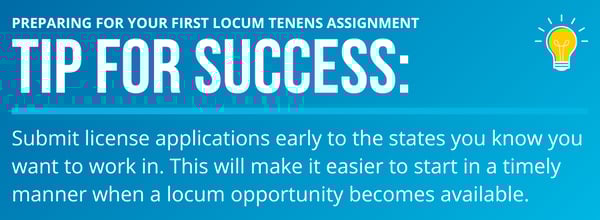
Before your locum tenens job begins, you will need to be fully licensed in the state where you will practice and credentialed by the facility where you will provide care. Understanding how these steps work can help make the process more predictable and help you avoid delays.
Key Steps:
- State License: You must hold an active medical license in the state where you’ll work. If you plan to take multiple locum tenens jobs in different states, applying through the Interstate Medical Licensure Compact (IMLC) can help streamline the process.
- A valid, unrestricted medical license in good standing
- A completed application submitted to the respective state medical board
- Proof of medical education and postgraduate training
- Verification of board certification (if applicable)
- Recent clinical experience and professional references
- Background checks, including fingerprinting, are required in some states
View license fees and timelines by state for physicians here, or click here for APRNS.
- Credentialing: Every healthcare facility requires credentialing and privileging before you can begin work. Most credentialing processes take 60 to 90 days and can extend to 120 days, depending on request volumes and the facility’s requirements.
Common documents requested during credentialing include:
- Proof of training, including residency and fellowship
- Verification of prior employment and work history
- Malpractice claims history
- All current medical licenses
- Curriculum vitae
- Fingerprints and background checks
- State medical licenses and DEA certifications
- Board certifications
- Immunization records
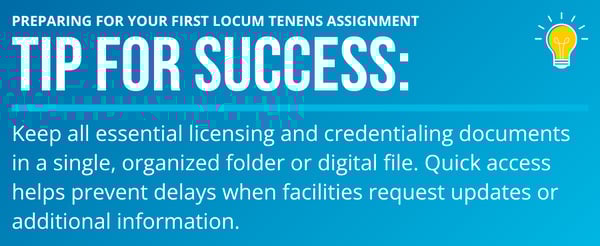
The Medicus Difference: When you partner with a locum tenens agency like Medicus for locum tenens jobs, you are supported by our in-house licensing and credentialing teams. Our teams review your documents, flag any missing items, and act as a liaison between you and medical staff offices throughout the process. Plus, the MedicusIQ Portal provides a secure, centralized platform for uploading, storing, and managing your credentialing and licensing documents with ease.
2. Travel and Housing Logistics
When working locum tenens jobs, travel and housing are usually arranged through your locum tenens agency. Knowing what to expect can help you stay organized and stress-free.
What to Expect:
- Travel: Most locum tenens agencies book flights or reimburse mileage for driving. If you prefer specific flight times, airlines, or seating options, communicate them to your recruiter early.
- Housing: Locum tenens agencies typically arrange accommodations based on the length of your locum tenens job.
- Short-term locum tenens assignments: Hotels or extended-stay suites
- Long-term locum tenens assignments: Furnished apartments or rental homes
- Transportation: Rental cars or local transportation are often included. Ask about reimbursement if you use your personal vehicle.
The Medicus Difference: When you take a locum tenens job with Medicus, our in-house travel team takes the lead on logistics. Our team books flights, arranges transportation, and secures housing that fits the length and location of your assignment. Your itinerary and confirmations are organized in the MedicusIQ Portal for quick access. You also have the opportunity to earn travel rewards through the MyMedicus Loyalty Program.
3. Understand Your Locum Tenens Contract and Schedule
Before your locum tenens assignment begins, make sure you fully understand the terms of your contract and your work schedule.
Important Details to Confirm:
- Locum tenens assignment length: Ranges from a few weeks to several months.
- Work hours: Typical schedules may include weekday shifts, night shifts, or 7-on/7-off rotations.
- On-call expectations: Confirm if call coverage is part of your duties.
- Compensation: Most locum tenens jobs are 1099 independent contractor positions.
- Payment terms: Know how and when you’ll be paid, and whether any bonuses or stipends apply.
Because 1099 physicians and advanced practitioners are responsible for their own taxes, health insurance, and retirement savings, consider consulting a financial advisor to help manage quarterly taxes and deductions.
The Medicus Difference: Fortunately, Medicus and most reputable locum tenens agencies offer malpractice insurance, cover travel costs, and often credentialing and licensing fees, saving you time and out-of-pocket expenses.
4. Plan for Life Outside of Work
Balancing work and personal life during a locum tenens job can help you feel comfortable and focused.
Before You Arrive:
- Research the area: find nearby grocery stores, pharmacies, gyms, and local restaurants.
- For interests, hobbies, or religious needs, look up related locations in advance.
- Pack food or snacks for your first shift in case hospital dining is limited.
Stay Prepared:
- Share your travel and assignment details with a family member or friend.
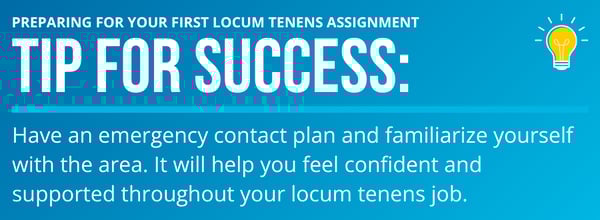
- Keep a list of essential contacts (your recruiter, travel coordinator, and facility manager).
- Know what to do in case of travel issues or emergencies.
5. Prepare Yourself for a New Clinical Environment
Each locum tenens job brings a new team, workflow, and setting. Being able to adapt quickly can help you feel confident and provide consistent patient care.
Learn the Facility:
Before starting, get familiar with the workplace:
- Review key policies and documentation requirements.
- Learn the EMR system and communication flow.
- Identify who to contact for scheduling or support.
Build Team Connections:
Strong teamwork makes every locum assignment smoother:
- Introduce yourself early and stay approachable.
- Ask questions respectfully and show flexibility.
- Appreciate the staff who help you adjust.
Stay Organized:
Keep essentials handy and track key details:
- Carry your credentials and notes on workflows.
- Record important contacts and shift details.
The Medicus Difference: When you partner with Medicus for locum tenens jobs, your recruiter is with you from the moment you accept an assignment through your final shift. They help you prepare for your new setting, answer questions along the way, and connect you with the appropriate facility contacts when needed. Their goal is to make sure you feel supported and informed throughout your assignment.
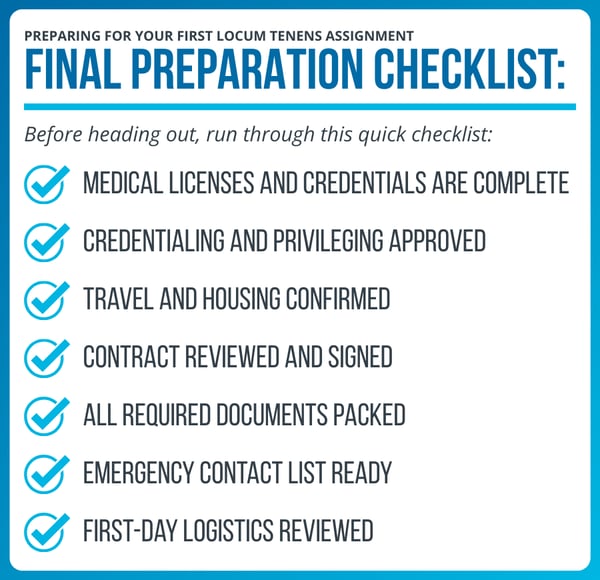
6. Final Preparation Checklist
Ready to Start Working Locum Tenens Jobs?
There is a lot to take in when you start your first locum tenens job, and preparing ahead of time gives you room to adjust at your own pace. Once the requirements and arrangements are behind you, the experience becomes more about the patients you meet and the team you join. Throughout that transition, Medicus is available when you need support or answers, giving you a reliable point of contact as you settle into your locum tenens assignment.
Ready to begin working locum tenens with Medicus? Click here to view our open locum tenens jobs or complete the short form below to connect with a Medicus recruiter.

-1.png)
.png)